However, repeatedly repairing a deteriorating roof can eventually cost more than addressing the underlying problem. Applying a coating over wet insulation or a failing roof assembly can also create additional expenses without delivering the expected results.
Choosing between commercial roof repair, coating, and replacement depends on several factors:
- The age and condition of the existing roof
- Whether the damage is isolated or widespread
- The presence of trapped moisture
- The condition of the membrane, insulation, and roof deck
- Drainage and ponding-water issues
- Previous repairs and recurring leaks
- Your long-term plans for the property
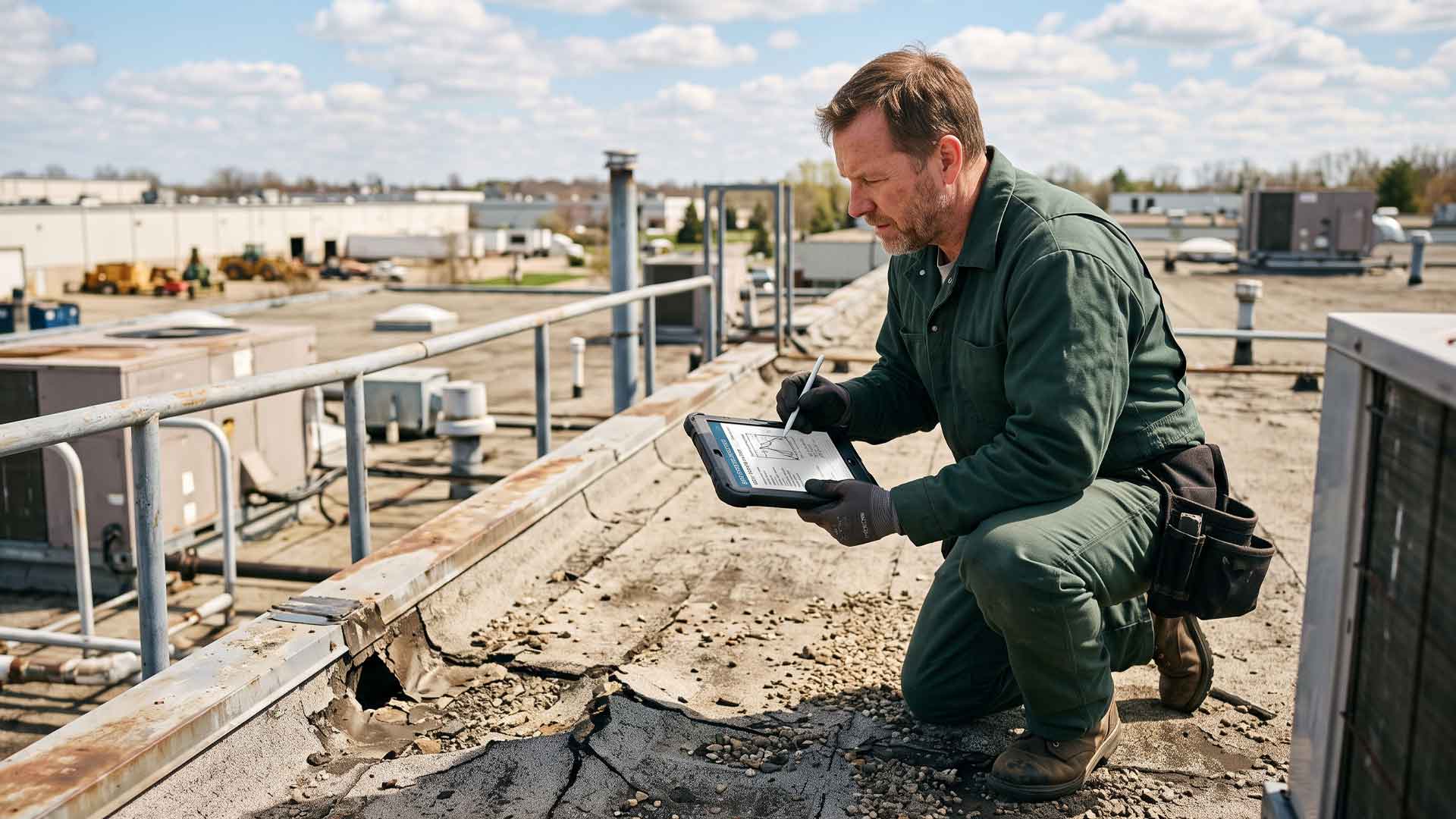
A professional commercial roof inspection can help you understand what is happening beneath the visible surface and determine which option provides the best long-term value.
Quick Answer
The right commercial roofing solution depends on the condition of the entire roof system—not just what is visible on the surface.
- Choose repair when the damage is isolated and the surrounding roof remains in serviceable condition.
- Consider a coating when the roof is structurally sound, mostly dry, and suitable for restoration.
- Choose replacement when moisture, deterioration, or recurring problems affect the broader roof assembly.
A commercial roof inspection is the most reliable way to determine which option provides the best long-term value for your property.
When Commercial Roof Repair Makes Sense
A commercial roof repair addresses a specific source of damage without replacing or restoring the entire roof surface.
Repair may be the most practical option when:
- A leak has a clearly identifiable source
- A seam, flashing detail, or roof penetration has failed
- Damage is limited to a small section of the roof
- The insulation and roof deck remain dry and structurally sound
- Most of the existing roof still has useful life remaining
- The problem can be corrected without disturbing the larger roof assembly
Common commercial roof repairs include resealing flashing, repairing damaged seams, patching punctures, correcting problems around rooftop equipment, and replacing isolated sections of damaged membrane or insulation.
The important distinction is whether the repair corrects the source of the problem or simply covers the visible symptom.
For example, water may travel along the roof deck or insulation before entering the occupied space. The location of an interior leak may not be directly below the original roof defect. A thorough inspection is often necessary to identify the actual entry point.
When Repairs May No Longer Be Enough
One repair does not necessarily indicate a failing roof. A pattern of recurring problems is more concerning.
It may be time to consider coating or replacement when:
- Leaks continue to appear in different areas
- Previously repaired sections begin failing again
- Maintenance costs are steadily increasing
- Large sections of the membrane show deterioration
- Moisture has spread into the insulation or roof deck
- The roof is approaching the end of its expected service life
Continuing to patch a deteriorating system can delay a larger project, but it may not provide dependable protection or the best lifecycle cost.
When a Commercial Roof Coating Makes Sense
A commercial roof coating is a restoration system applied over an existing roof. It is designed to protect a suitable roof surface, improve waterproofing, and extend the roof’s service life without completing a full tear-off and replacement.
Before applying a coating, the existing roof must be inspected, cleaned, prepared, and repaired. Wet or damaged materials may need to be removed and replaced before the coating system can be installed.
A commercial roof may be a good candidate for coating when:
- The roof and underlying deck are structurally sound
- Existing leaks can be identified and repaired
- Trapped moisture is limited
- The existing membrane remains suitable for restoration
- Drainage is functioning properly
- Surface preparation can create reliable adhesion
- The owner wants to reduce tear-off, waste, and operational disruption
Because a coating is installed over the existing system, it can be less disruptive than a complete roof replacement. That can be particularly valuable for occupied offices, retail centers, multifamily buildings, warehouses, and other properties where operations must continue during the project.
What a Roof Coating Cannot Fix
A coating is not a substitute for necessary roof repairs, and it cannot restore a structurally compromised assembly.
A coating may not be appropriate when:
- Insulation or the underlying substrate is widely saturated
- The roof deck has experienced significant deterioration
- Leaks are widespread or cannot be reliably corrected
- Persistent ponding water cannot be resolved
- The roof membrane is beyond its useful service life
- The existing surface is incompatible with the proposed coating
- The roof has broader structural or drainage problems
Applying a coating without addressing these conditions can trap existing problems beneath the new surface. That is why a moisture assessment and documented roof inspection should occur before selecting a restoration system.
When Commercial Roof Replacement Is the Better Investment
Commercial roof replacement involves removing and rebuilding some or all of the existing roofing assembly. Although it requires a larger project scope, replacement may provide better long-term value when the existing roof can no longer be reliably repaired or restored.
Replacement may be the better option when:
- The roof has recurring leaks across multiple areas
- Moisture has spread throughout the insulation or substrate
- The membrane shows widespread cracking, separation, or deterioration
- The roof deck or supporting assembly has been compromised
- Drainage problems cannot be corrected through limited repairs
- The current roof is near or beyond its expected service life
- Ongoing repairs are producing diminishing returns
- The building is preparing for solar or another long-term rooftop investment
A replacement project also gives the property owner an opportunity to evaluate the entire roof assembly rather than simply replacing the visible surface. This may include insulation, drainage, flashing, attachment methods, rooftop equipment, edge details, and the building’s future energy needs.
How Colorado Conditions Affect the Decision
Commercial roofs in Colorado face a demanding combination of environmental conditions.
Colorado hail can puncture roof membranes, damage coatings, dent metal components, and weaken the surface of a commercial roofing system. High winds, heavy snow, and wind-driven debris can also stress seams, flashing, drainage points, and previous repairs. Intense sunlight, high-altitude UV exposure, temperature swings, and repeated freeze-thaw cycles add further wear over time. After a significant weather event, a professional inspection can identify storm damage before it develops into leaks or more extensive roof deterioration.
These conditions do not mean every damaged commercial roof needs replacement. They do make it important to evaluate the complete system after a major storm or when recurring problems begin to appear.
Damage that looks minor from the roof surface may have affected insulation or other components below it. Conversely, a visible defect may still be repairable when it is identified early and the surrounding assembly remains sound.
Comparing the Long-Term Cost of Each Option
The option with the lowest initial price is not always the option with the lowest long-term cost.
When comparing repair, coating, and replacement, commercial property owners should consider:
- The expected remaining service life of the roof
- The likelihood of additional repairs
- The cost of interior water damage or business disruption
- The condition of the insulation and its effect on energy performance
- Available warranties
- Future maintenance requirements
- Plans to retain, renovate, refinance, or sell the building
- Future solar, HVAC, or rooftop-equipment projects
A targeted repair can provide excellent value when the problem is genuinely isolated. A coating can extend the life of a suitable roof while reducing disruption and tear-off. Replacement may be the better financial decision when additional repairs would continue consuming money without providing dependable performance.
The goal should not be to choose the least expensive proposal. It should be to select the solution that fits the roof’s actual condition and the owner’s plans for the property.
How a Commercial Roof Inspection Clarifies the Decision
The visible roof surface only tells part of the story. Before recommending repair, coating, or replacement, a commercial roof inspection should evaluate:
- Membrane and surface condition
- Seams, flashing, penetrations, and edge details
- Drainage and evidence of ponding water
- Visible signs of trapped moisture
- Insulation and substrate conditions
- Previous repairs and recurring problem areas
- Storm, wind, or hail damage
- The roof’s approximate age and remaining service life
- Compatibility with a coating or restoration system
- Readiness for solar or other rooftop improvements
Additional diagnostic work, such as moisture testing or infrared scanning, may be appropriate depending on the roof and the problems being investigated.
The result should be a documented assessment that explains what is happening, which options remain viable, and why a particular solution is being recommended.
Schedule a Commercial Roof Inspection
What If the Roof Needs Replacement, but Capital Is the Obstacle?
Sometimes the condition of the roof makes replacement the clear recommendation, but the property owner still needs to protect working capital or avoid a large upfront expense.
Qualifying Colorado commercial properties may be able to use Commercial Property Assessed Clean Energy financing, commonly known as C-PACE, for eligible energy-efficient roof replacement projects.
A commercial roof may be considered as part of a qualifying C-PACE project when the new assembly delivers measurable energy-related improvements. That may include upgraded insulation, reflective roofing materials, solar preparation, or a combined roofing and solar project.
C-PACE eligibility depends on the property, proposed improvements, location, existing financing, and current program requirements. It is not the right solution for every building, but it can give eligible owners another way to approach a necessary capital improvement.
Peak Roofing + Solar can evaluate the roof’s condition and complete an initial review of whether a replacement project may be a candidate for Colorado C-PACE financing.
Not Sure Whether to Repair, Coat, or Replace Your Commercial Roof?
You should not have to make a major roofing decision based on guesswork.
Peak Roofing + Solar can inspect your commercial roof, document its current condition, and help you compare the most practical options for your building. If replacement is recommended, our team can also review whether the project may qualify for Colorado C-PACE financing.
Request a complimentary commercial roof inspection to understand your options.
Can a leaking commercial roof be coated?
Possibly, but the source of the leak must first be identified and repaired. A coating should not be used to cover active leaks, saturated insulation, or broader structural problems.
How do I know whether my commercial roof needs repair or replacement?
Localized damage on an otherwise serviceable roof may be repairable. Recurring leaks, widespread moisture, extensive deterioration, or an aging roof assembly may indicate that replacement provides better long-term value. An inspection is necessary to determine the actual scope.
How long can a commercial roof coating extend a roof’s life?
The expected service life depends on the roof’s existing condition, the coating system, surface preparation, installation quality, ongoing maintenance, and warranty. The roof must first be confirmed as a suitable candidate for restoration.
Can TPO or EPDM roofing be coated?
Some TPO and EPDM roofs may be suitable for compatible coating systems. The existing membrane must be inspected for moisture, adhesion, deterioration, and other conditions before a coating is selected.
Should a commercial roof be replaced before installing solar?
The roof should be inspected before solar is installed. If the roof is unlikely to last as long as the planned solar system, replacing it first may prevent the expense and disruption of removing and reinstalling solar equipment later.
Can C-PACE finance a commercial roof replacement?
Qualifying commercial roof replacements may be eligible when they improve the building’s energy performance or support other eligible improvements. Approval depends on the property, project scope, location, and applicable Colorado C-PACE requirements.



.svg)

